I built ryvl because I kept watching good local businesses lose to worse ones and not know why.
If you own a cafe, a clinic, a studio, a shop, you can feel when a rival down the street is pulling your customers. What you cannot see is the reason. You do not sit in their dining room. You do not hear what their customers grumble about on the way out. So you guess. You run a discount. You change your hours. You repaint the sign. And you hope.
The strange part is that the answer is already public. It is sitting in your competitors’ Google reviews, written by their own customers, in plain words. People say exactly what they loved and exactly what made them never come back. Nobody has time to read hundreds of those reviews across four or five rivals and turn them into a plan. So the signal just sits there.
ryvl reads it for you. Give it your business and a few nearby competitors. It pulls their real Google reviews, finds the one weakness customers keep naming, and turns that single finding into two things at once: the ad campaign you should run, and the product or operations ticket you should build. One insight, two outputs, on one screen.
It is live now at ryvl.info, and you can try it free.

The ryvl homepage. The whole product in one line: turn a rival’s reviews into the ad and the ticket.
The problem, stated plainly
Local owners are flying blind on the one thing that decides whether they grow: why customers pick the place across the street.
You have your own reviews, sure. But your reviews tell you about you. They do not tell you where your rival is weak, which is where your next ten customers are hiding. Competitive intelligence has always been a big-company luxury, built on survey panels and analyst decks that a neighborhood business will never pay for.
Meanwhile the raw material is free and specific. A one-star review that says “the staff almost threw the receipt at me” is worth more than any survey. It is a customer telling you, unprompted, exactly where the door is open.
The insight: read the reviews, find the one gap that matters
ryvl’s whole engine starts from real Google reviews. Not summaries, not vibes, the actual text people wrote.
A frontier language model (the analysis runs on Anthropic’s Claude) reads across every competitor and pulls out a structured map of strengths and weaknesses on the dimensions customers actually talk about. Then it does the hard part: it picks the single sharpest weakness, the one a rival keeps getting dinged for, recurring and strong enough to build a plan around.
That selection happens once, in code. Everything downstream points back to it. That matters, and I will come back to why.

Every report opens here. One competitive read, built from real reviews, with the sharpest weakness called out in a sentence: “They’re losing customers on staff friendliness.”
The centerpiece: one insight, two outputs
This is the part I am proudest of, and it is the heart of the product.
Once ryvl has found the one weakness, it shows it to you two ways, side by side, on a screen I call the Split.
On the left is the Marketer view. It takes the rival’s weakness and turns it into an angle you can act on this week: a positioning line, an ad campaign, ready-to-run copy. If the place across the street is losing people on rude service, the angle writes itself, and ryvl writes it for you.
On the right is the Product view. The same weakness becomes a product brief and a ready-to-file ticket: here is the problem, here is who it affects, here is the work to ship. It is the build side of the same coin.

The Split. One weakness, “rude and dismissive staff,” becomes the campaign to run on the left and the work to ship on the right. Both halves are pinned to the same gap in code, so they never drift apart.
Two teams, two languages, one truth. The marketer and the product manager are usually looking at different documents and arguing about priorities. Here they are looking at the same finding, expressed in each of their dialects, derived from the same customer in the same review. That is what I mean by one insight, two outputs. It is not a slogan. The two halves are mechanically tied to the one weakness the engine selected, so they cannot wander apart into two different stories.
The rest of the workspace
The Split is the centerpiece, but a report is a full workspace, not a single page. A left rail groups everything into Overview, Intelligence, Action, and Trust. Here is what is inside.
Reputation gap map
Every business scored on the dimensions customers actually raise, so you can see at a glance where you lead and where you trail. A star marks the leader on each row. And when the reviews never touch a dimension, the cell stays blank instead of inventing a number.

The gap map. Cafe Grumpy leads on coffee, atmosphere, and space, but the rivals are not far behind on food, and one dimension shows “n/a” because the reviews stayed silent on it. Honest blanks, not guesses.
Verbatim quote mining
The themes across each rival’s reviews, each one backed by the exact lines customers wrote. You can filter by rival and by tone, praise or complaint or neutral, and read the actual words. Every quote shown is the real thing, copied straight from a real review.

Quote mining. Recurring themes per rival, each line a verbatim quote with the reviewer’s name and rating. “Staff almost throwing the receipt at me” is not a paraphrase. It is what someone wrote.
Customer segments
Who each rival wins and who they lose: families, couples, solo and remote workers, tourists. Inferred from who shows up in the reviews and how they talk, so you can see which customers are up for grabs.
Price perception
A simple one-to-five read on whether customers feel each place is overpriced or a steal, drawn from how they talk about price. When a rival’s reviews never mention price, the index stays blank.
Campaign creative studio
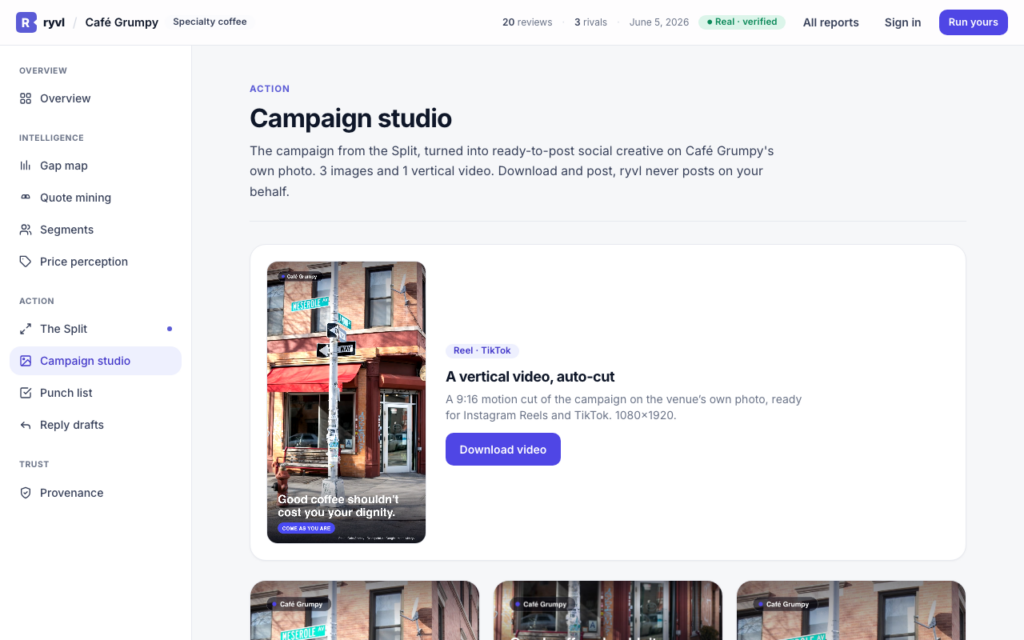
This is where the marketing angle becomes something you can actually post. ryvl composites the campaign copy onto the venue’s own real Google photo and produces ready-to-post social creative: Facebook and Instagram images and a 9:16 vertical video for Reels and TikTok. You download it and post it yourself. ryvl never posts on your behalf.

Campaign studio. The angle from the Split, composited onto the real venue photo as a vertical video and a set of social images. “Good coffee shouldn’t cost you your dignity,” cut and ready to download.
Operational punch-list
The gaps turned into a short, prioritized to-do list, each item tagged by priority and effort, so vague sentiment becomes a list you can work through this week.
Review reply drafts
Warm, specific draft replies to your own notable reviews, with a copy button. Nothing is ever posted automatically. These are drafts you read, tweak, and send yourself.
How ryvl stays honest
I care a lot about this, because the easiest thing in the world would be to let a language model write something plausible and call it intelligence. ryvl refuses to do that, and there are real mechanisms behind the refusal.
Every quote is verbatim. Before any report ships, each quote is checked to be an exact substring of a real, stored review. If a single quote cannot be matched back to a real review, the build fails. Not a warning, a failure. A report with an invented quote never reaches you.
When the reviews are silent, ryvl says so. If customers never talked about a dimension, the gap map leaves the cell blank and the price index stays empty, rather than filling the space with a confident guess. Honest blanks beat fluent fiction.
The two outputs cannot drift. The marketer’s ad and the product manager’s ticket are both pinned, in code, to the one weakness the engine selected. They are two views of the same fact, not two independent essays that happen to sit next to each other.
The sample reports are real runs. The examples on the site are committed snapshots of real pipeline runs on real businesses. Nothing on the page is mocked up to look good for a screenshot.
That is the line I hold. ryvl would rather show you less and have all of it be true than show you a polished story that does not hold up.
Try it free
ryvl is live at ryvl.info. The homepage carries a 20-second silent tour of a real report, and a gallery of sample reports you can click through right now, no signup needed.
When you are ready, point it at your own business and a few competitors and watch it run the real pipeline live. You get a free run to start, and a signed-in account gives you more.
If you run a local business and you have ever stood in your own doorway wondering why the place across the street is busier, this is for you. The answer is already written down. ryvl just reads it, and hands you the two things to do about it.
Go try it: ryvl.info.